Six places where coordination works or breaks
A lens to see them. Something you can try.
The six dimensions
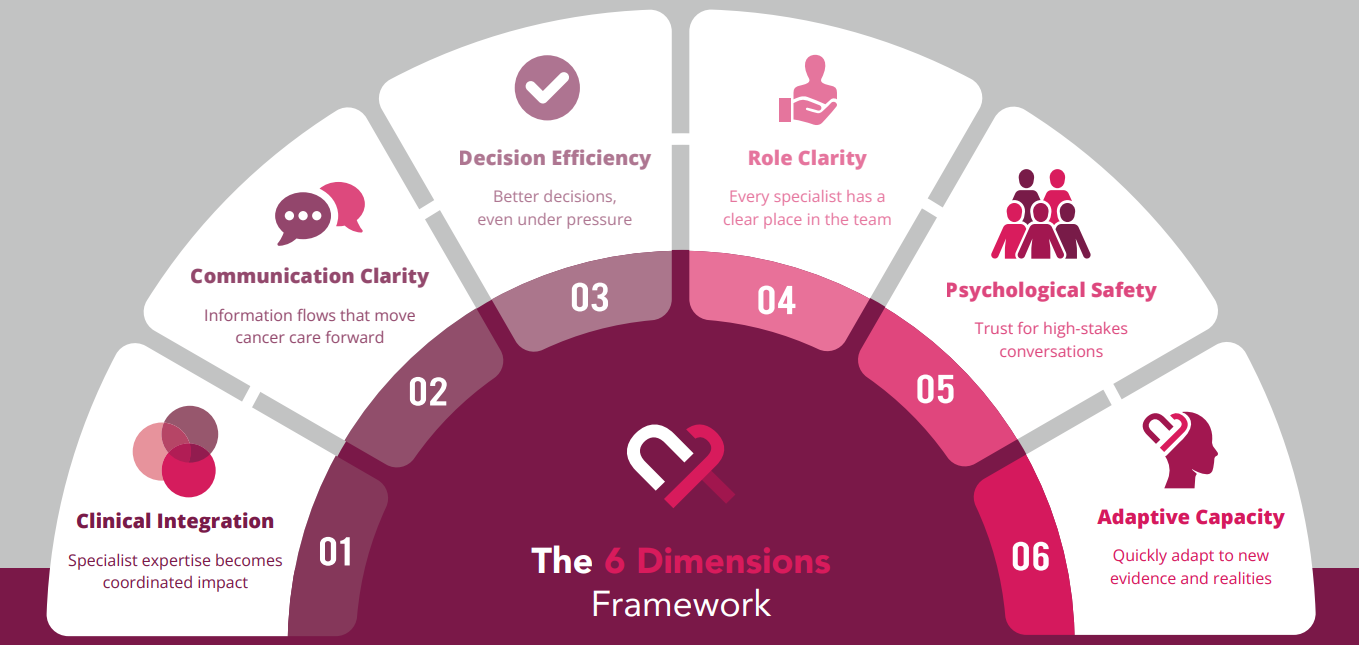
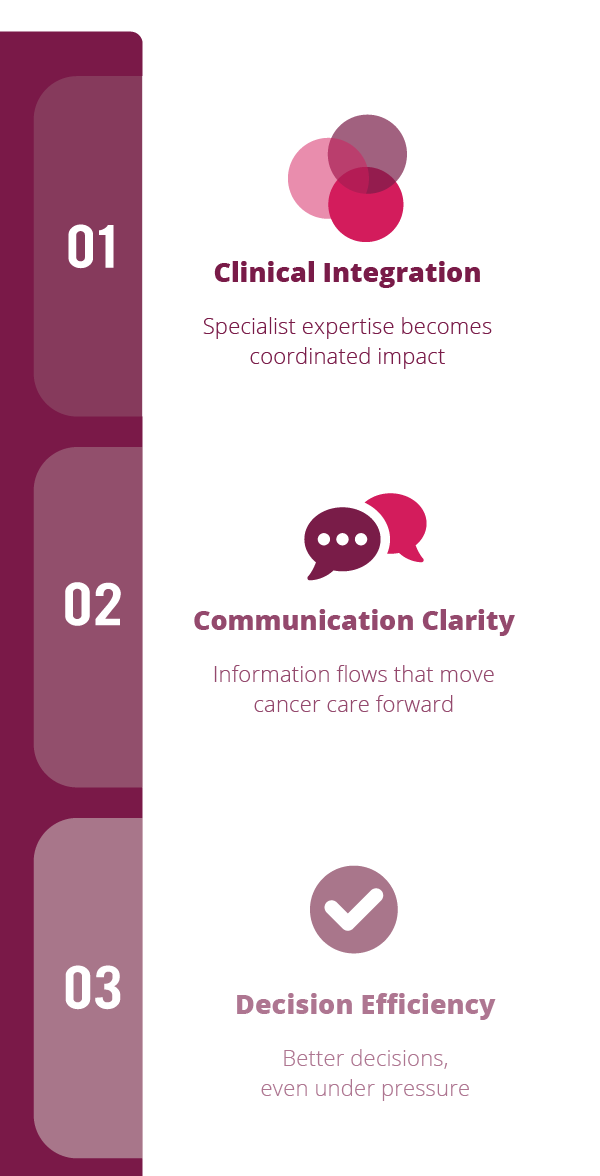
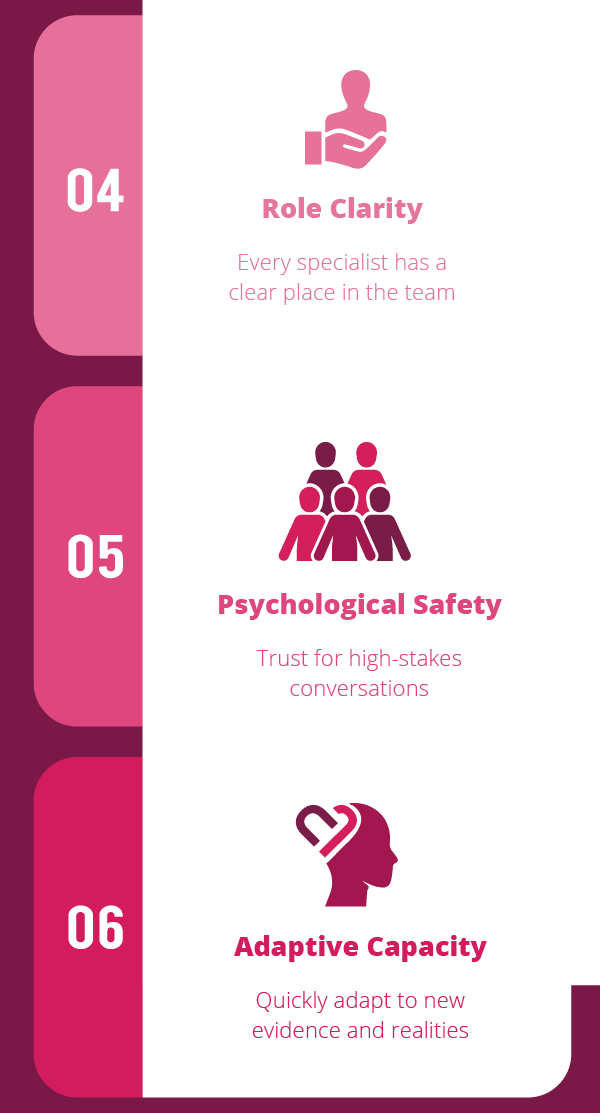
Coordination in cancer care is not one thing. It is six things happening simultaneously, each measurable, each actionable.
These are not abstract concepts. They are the places where your team's coordination either holds or gives way. When you know where to look, you can see which ones are working and which ones are under strain.
These are the six places where coordination works or breaks in your team. The study measures all of them.
Why this matters
The patient was 45, a mother of two in Vienna, presenting with aggressive breast cancer. When the genetic analysis came back HER2-positive, everything changed.
In 1995, HER2-positive meant certain death within months. By 2005, trastuzumab offered hope. By 2015, the CLEOPATRA regimen transformed survival. By 2025, antibody-drug conjugates (ADCs) and targeted therapies could reach brain metastases. What used to be a death sentence became years of watching children grow up.
But each breakthrough demanded more sophisticated coordination. Trastuzumab needed cardiac monitoring. CLEOPATRA required combination precision. Today's ADCs demand genetic confirmation, toxicity protocols, and brain monitoring across several specialists.
The orchestra had to evolve to face the music.
The science evolved. The coordination infrastructure did not. What held the system together was absorbed by the people closest to the gaps. It runs on informal knowledge, personal relationships, and workarounds accumulated over years. It has no job description. It has no dataset.
The Six Dimensions Framework names where that coordination lives and where it breaks.
Where this comes from
The Six Dimensions Framework emerged from analysis of 69+ peer-reviewed studies on healthcare team coordination across 25+ countries. We have recognised six patterns that appear independently across the research literature, each with its own vocabulary, now unified into a single lens.
The Cancer Care Coordination Study is measuring these dimensions in real teams right now. Respondents from seven countries. Findings submitted to ESMO/EONS Congress 2026. Every completion sharpens the picture.
Something you can do
You do not need a programme to start. You need one experiment.
The coordination challenges in your team did not arrive overnight and will not go away overnight. You have a sphere of influence. Inside that sphere, you can act, try something small and see what happens.
The experiments
Pick something within your reach. Try it once.
• If it shifts something, keep it.
• If it partially works, tweak it.
• If it does not work, pivot.
That tells you something important about where the real constraint is.
The point is not the intervention. The point is learning what works in your system.
One experiment to try
An Adaptive Capaciry MicroShift
A simple practice that strengthens team connection and builds adaptive capacity.
Choose your next step.
Keep · Tweak · Pivot
If you want to see where your team stands across all six dimensions, the study takes ten minutes.
69+
Peer-Reviewed Studies
10+
Countries Represented
2026
ESMO/EONS Congress
45+
Oncology Studies
20+
Systematic Reviews
8+
Cancer care roles